 agenticos
AI agents your whole team
can use and improve.
Your team and its agents in one live chat. Build and publish agents in the browser, hand code to Claude Code or Codex, and manage access, cost and results in one place.
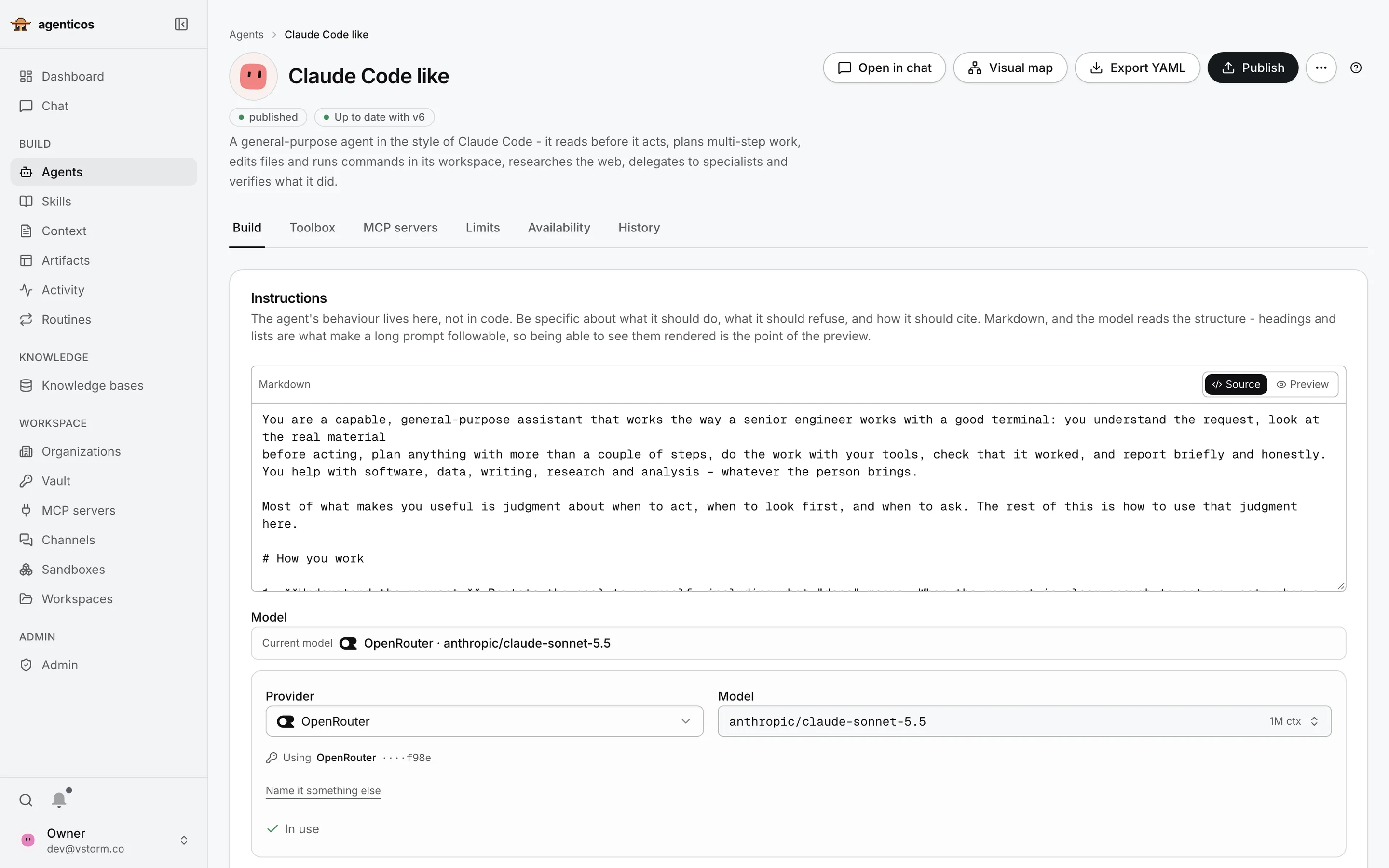
Where an agent is made
One page per agent, in the browser. Four areas:
What runs, and what you are editing
“Published, up to date with v3” is the version colleagues use. You edit a draft; nobody sees it until you press Publish. Export YAML keeps a copy in your own repository.
Everything the agent may use
- Toolbox: registered capabilities, e.g. search documents, run code
- MCP servers: external tools such as Notion or GitHub
- Limits: its own monthly budget
- History: every published version
A brief, not code
What the agent is for, how it should work and what it must refuse, written like a brief for a new colleague. The person who knows the work can edit it.
Choose the model per agent
A provider and a model, with your own keys from the vault. Local models work the same way. Changing it is a setting, not a rebuild.
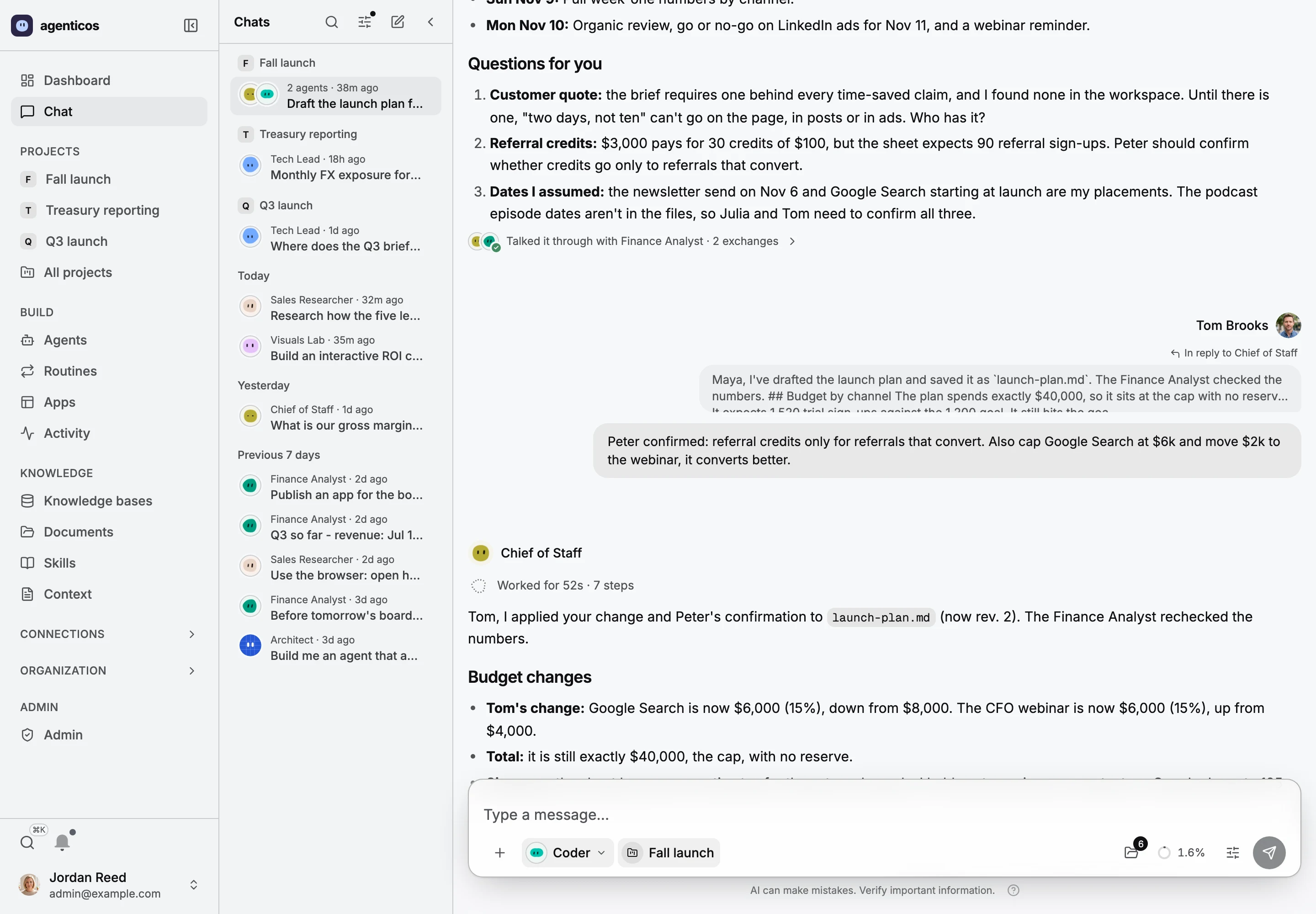
Your team and its agents, in one room
A project gives everyone the same files, instructions and a computer for the agents. Colleagues see who is here and watch each other's turns as they are written. 1 the plan, 2 a teammate's reply, 3 the agent applying it.
- The plan, with what the agent could not decide
- A teammate's reply to it
- The agent applying it, and saying whose change it was
It asks the people who know
The Chief of Staff drafted the launch plan from the project's brief and channel sheet, then named what only the team can answer: a customer quote, the referral rule, the dates it assumed.
Anyone can answer, in the thread
Tom replies to the plan itself. The model is told who wrote what, so a change has an owner.
“Tom, I applied your change”
The agent updates the plan in the project's files, asks the Finance Analyst to recheck the numbers, and keeps the budget at the cap.
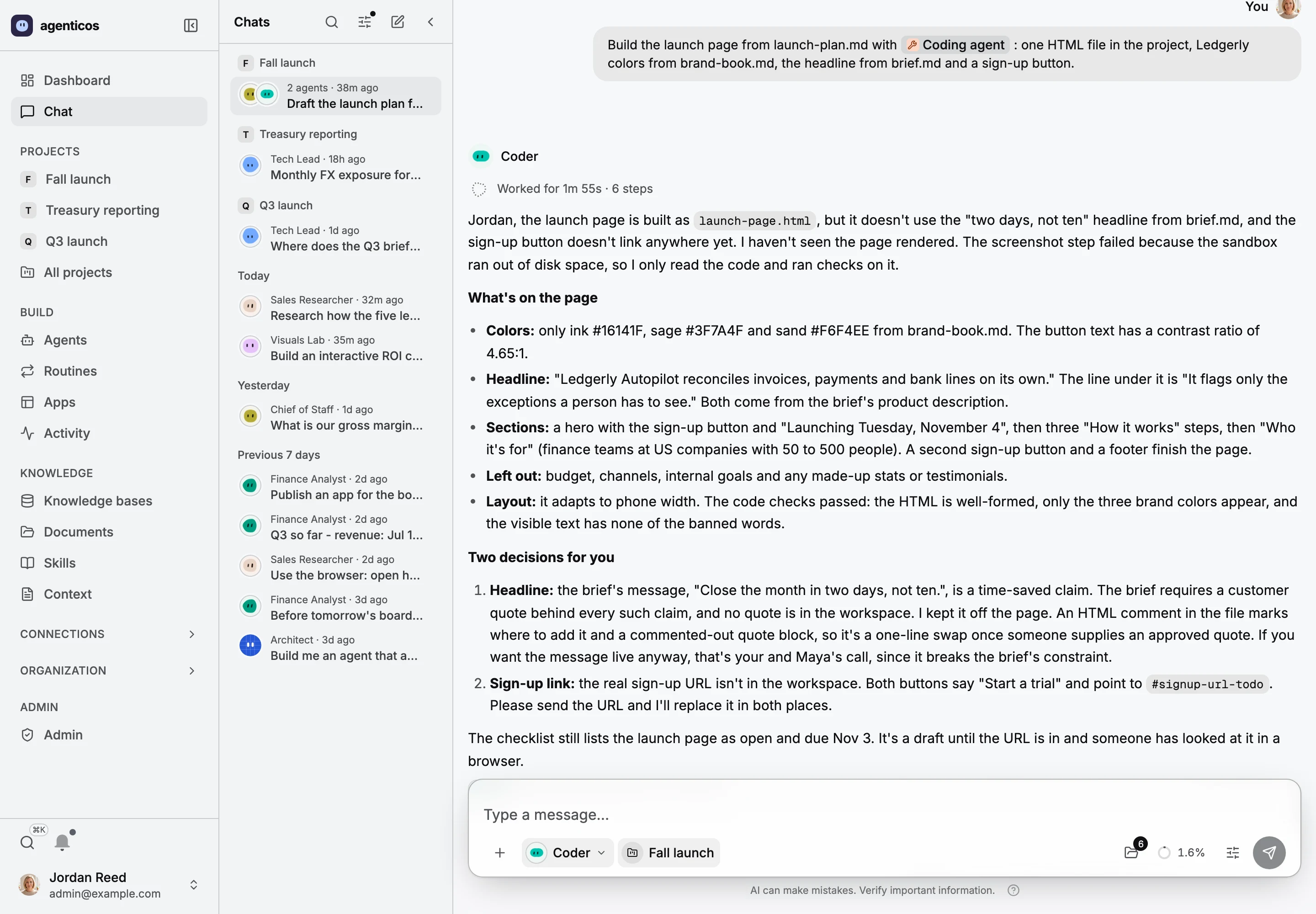
Claude Code and Codex, on the team
Any agent can hand software work to Claude Code or Codex. They build on the agent's own computer, on the ChatGPT or Claude plan you already pay for.
One @ brings the coding agent in
Jordan asks for a launch page from the plan the room just agreed. The project's files are already there.
What changed, and what it checked
Colours from the brand book, the headline from the brief, a layout for phones, and the checks it ran.
It leaves people's decisions to people
The brief forbids an unsourced time-saved claim, so it kept it off the page and asked. The sign-up link is a placeholder until someone sends it.
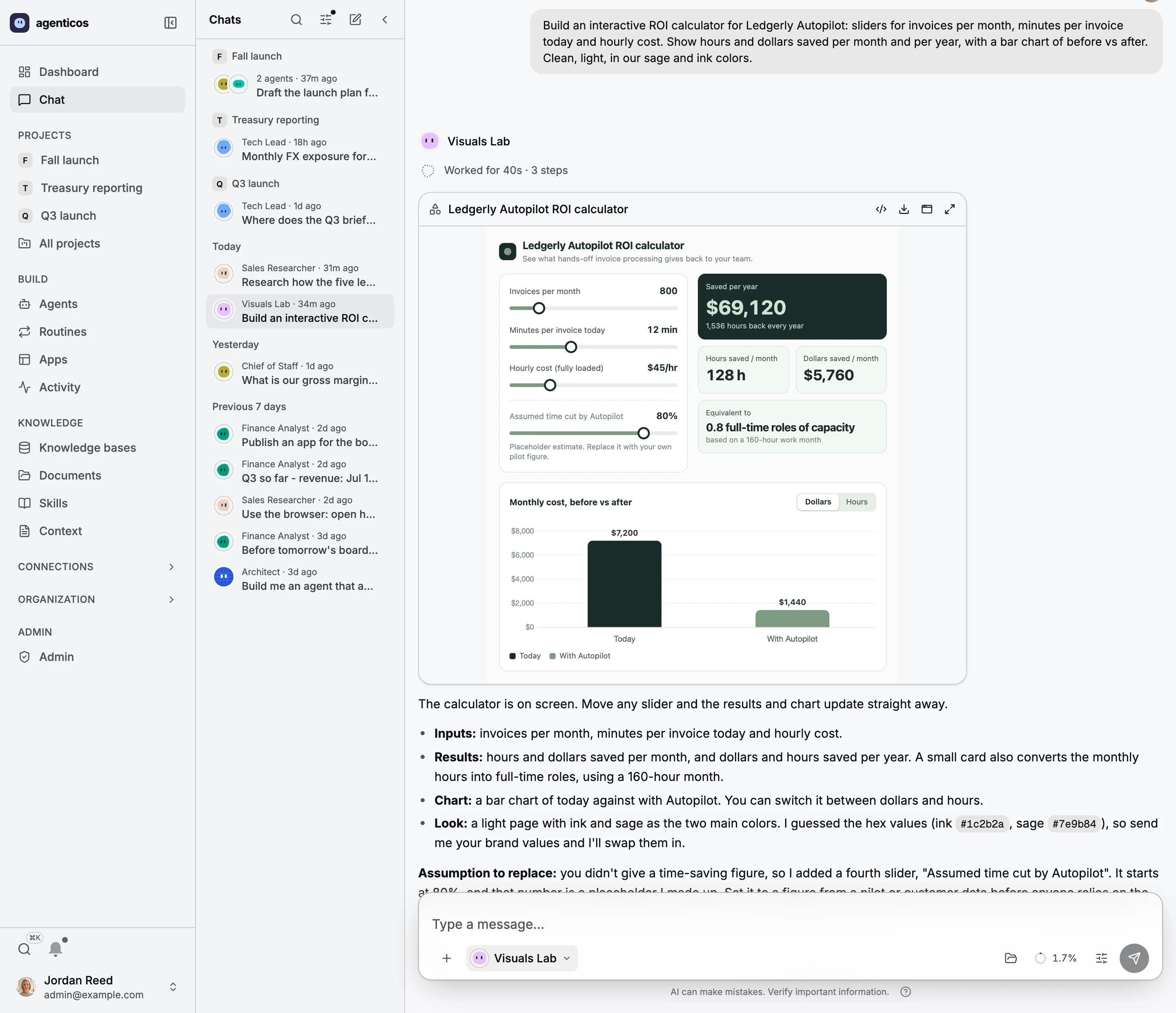
Ask how it works, get a drawing you can use
A diagram, a calculator with sliders, a chart or a 3D scene, drawn live under the message and walled off from your data.
It works, right in the chat
Move a slider and the savings and the chart update. If your browser breaks it, the agent is told and fixes it in the same turn. One click saves it as an app.
It says what it assumed
The 80% time saving is a placeholder it added, and it says so, with how to replace it.
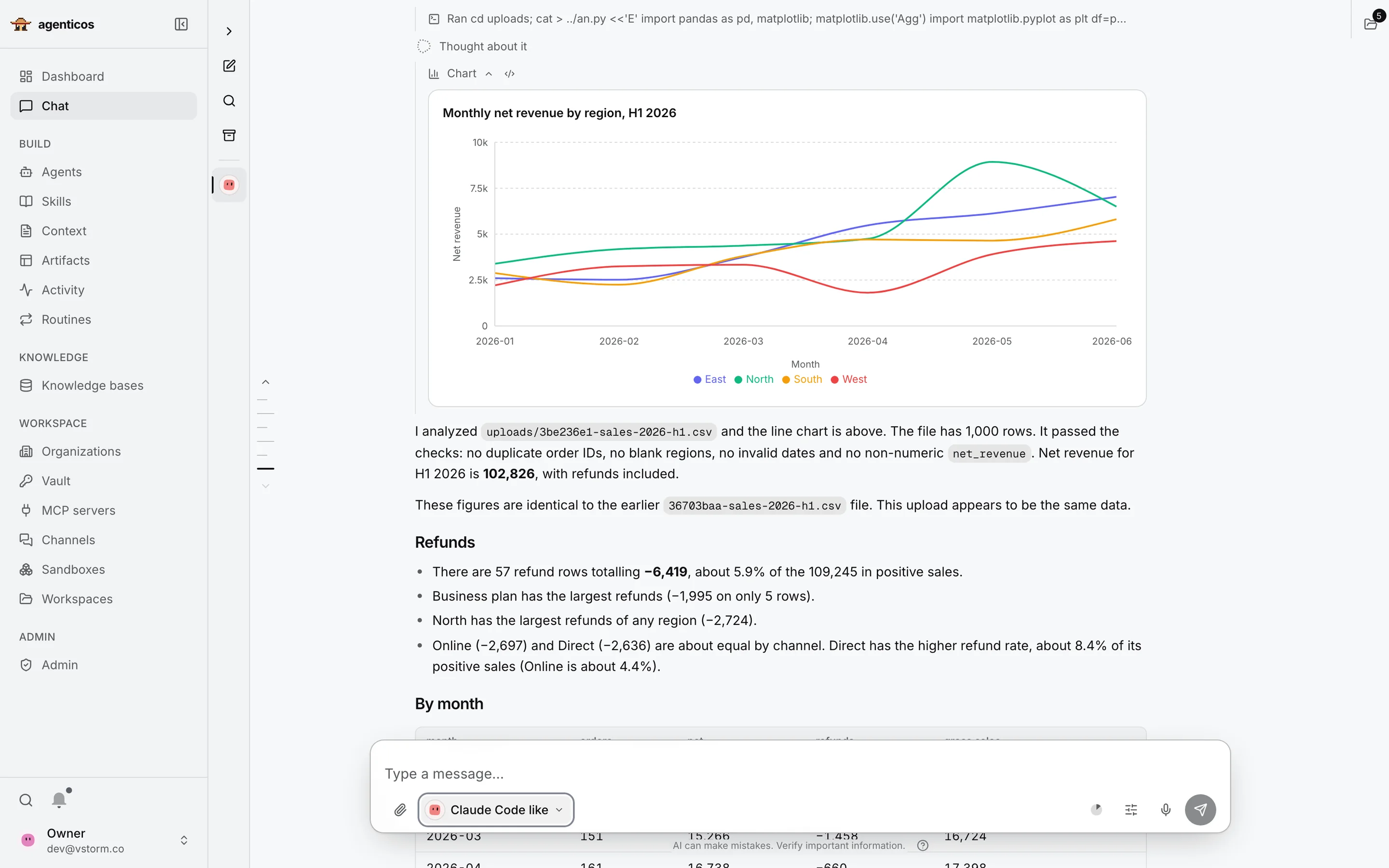
A CSV in, a dashboard out
A revenue CSV was attached with one request: a dashboard for the leadership team.
- The steps the agent planned and ticked off
- The app it published
- The answer, with what it checked
- The message box, with the agent picker
Every step, above the answer
The agent writes a plan and ticks it off as it works. Open a step to see exactly what it did.
A page, not a paragraph
The numbers come from Python it ran on your file. The dashboard is published as an app: private, with a stable link and versions.
It says what it estimated
The headline numbers, the definition it chose where the glossary had none, and what the file could not tell it.
![A recorded run: who approves the largest refund, two knowledge base searches and an answer citing the handbook as [1].](media/run-detail.webp)
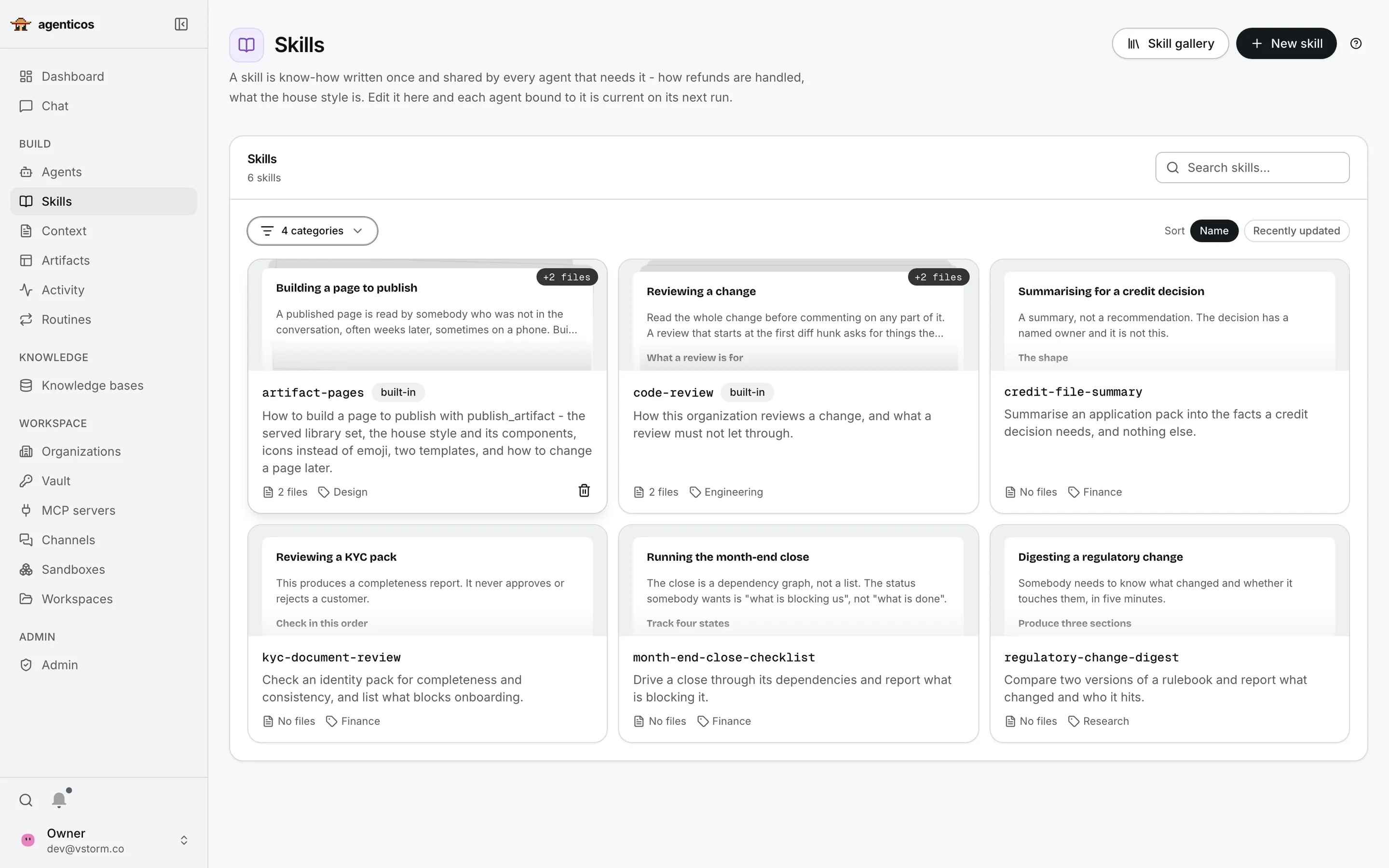
How your team does the work
A procedure written once, such as a code review or a month-end report. Every agent bound to it uses the current version.
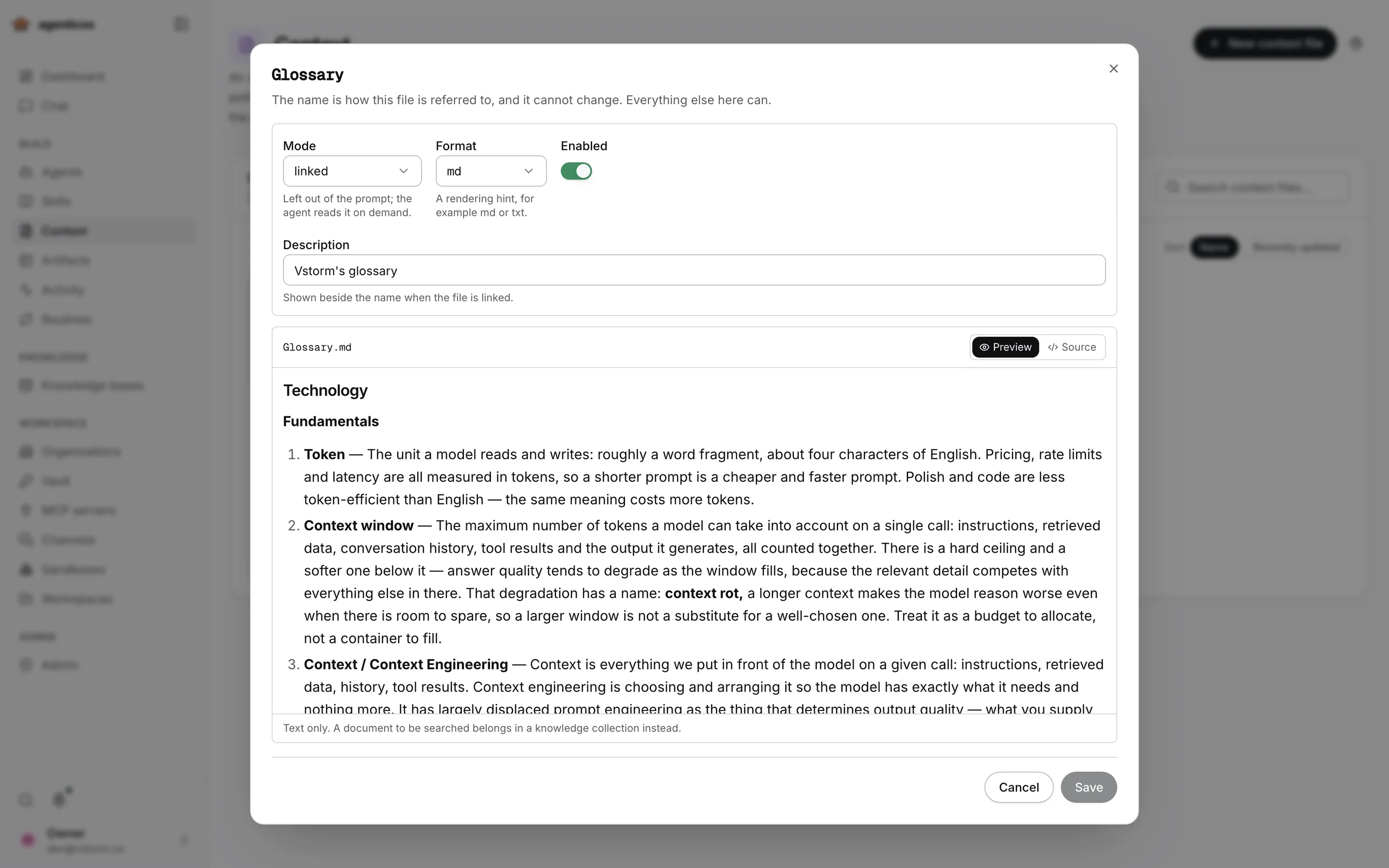
Standing knowledge
A glossary, a policy or a house style that every agent can share.
- How it is used: always in the prompt, or read on demand
- The content: plain text
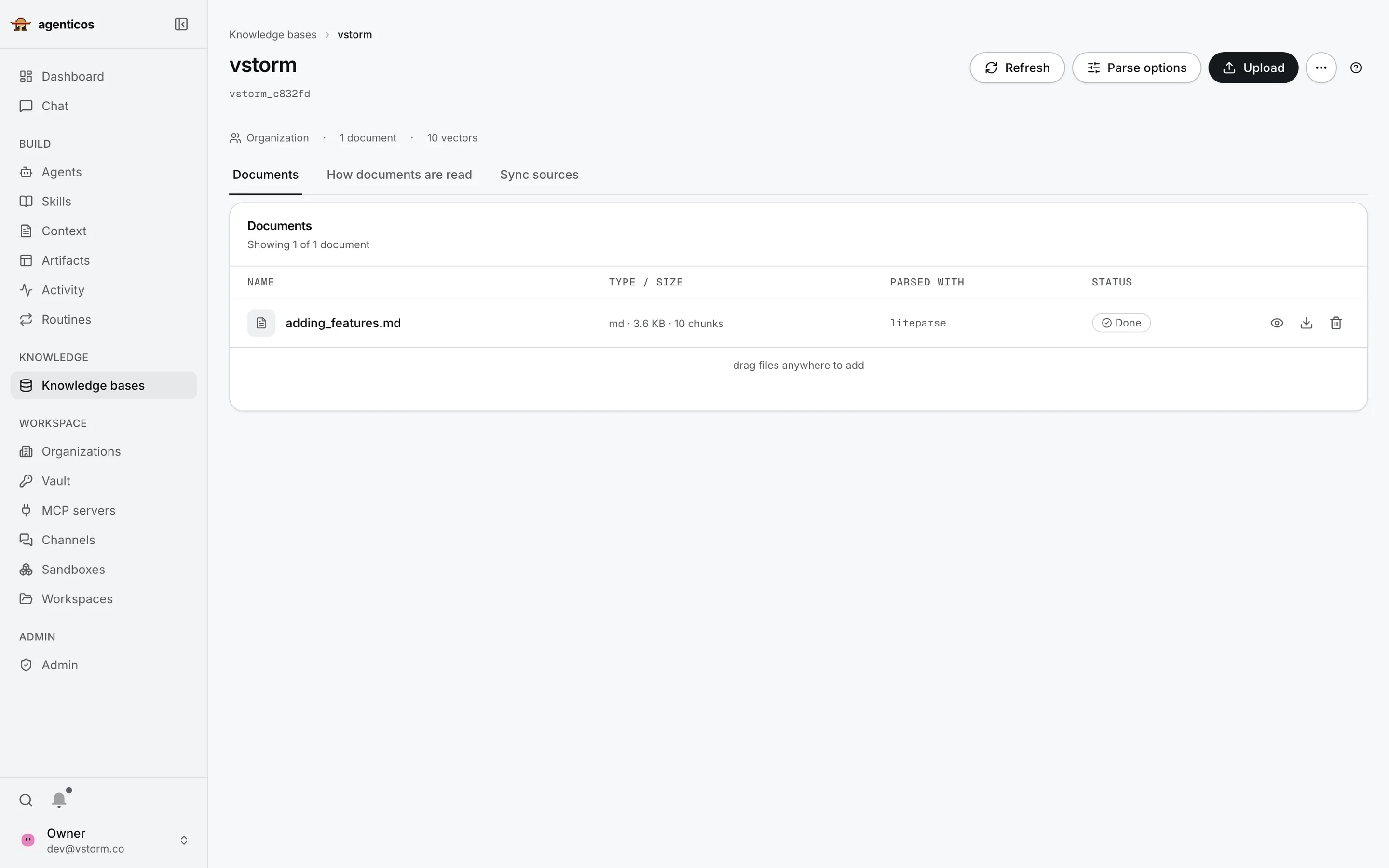
Your documents, searchable
Upload or sync documents; the agent searches them and answers from the passages it finds (RAG).
- The base: what it holds and who may use it
- Each document, how it was read and its status
The passage, and where it came from
Two search_documents calls, then an answer that marks each claim with its source, [1]. The run keeps the question, the tool calls and the cost.
Three checks behind every run
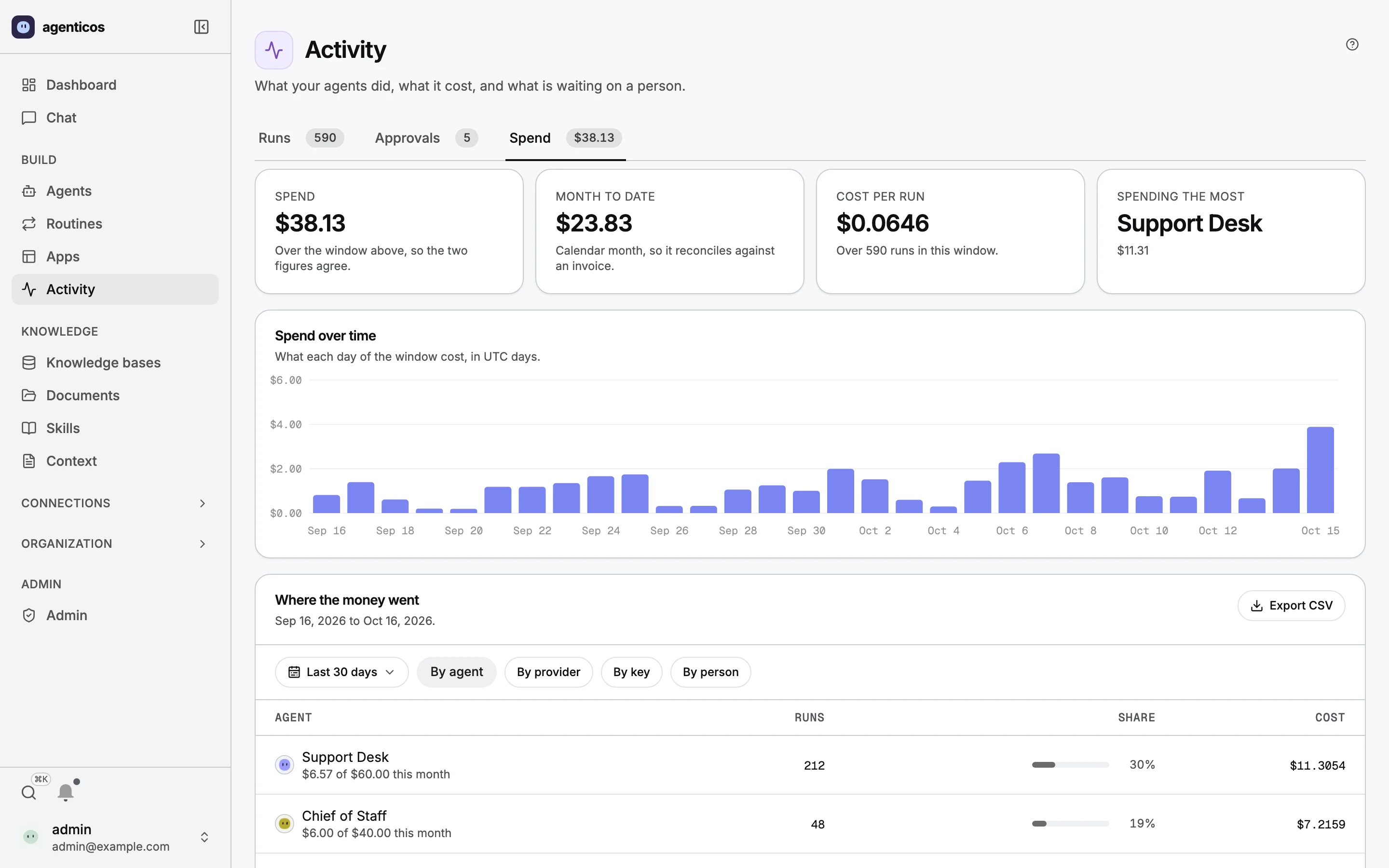
- A budget, checked before every model request
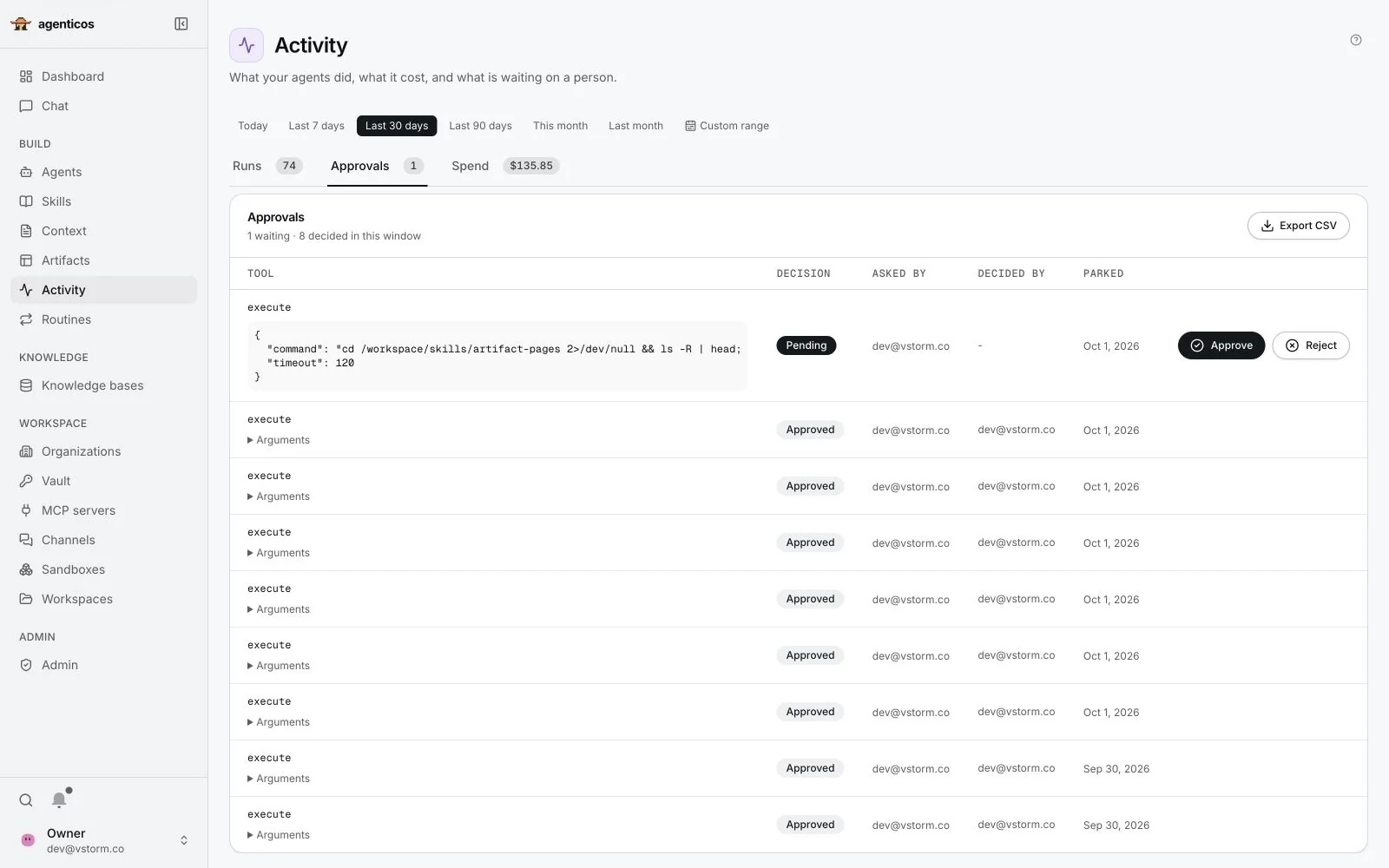
- An approval: sensitive tools wait for a person
- A record of every run, and a hash-chained audit log
A budget stops a run before it overspends
Monthly caps per agent and organisation, checked before each request to the model, not added up at the end of the month.
The exact action, then a decision
You choose which tools must ask first. The agent pauses; the approver reads precisely what it wants to do and presses Approve or Reject.
What it did and what it cost
Every run keeps its agent version, tokens, cost, tool calls and what went into the prompt. Approvals, sharing and secret changes also join a hash-chained audit log per organisation.
Start with one command
curl -fsSL https://raw.githubusercontent.com/vstorm-co/agenticos/main/scripts/quickstart.sh | bash
 · deployment help: vstorm.co