
AgenticOS vs Dify
Build the agent.
Bring the team.
Choose the workspace around the agent: shared Projects, explicit workflows, reusable knowledge and work people can inspect.
Apache-2.0 · self-hosted · built on Pydantic AI
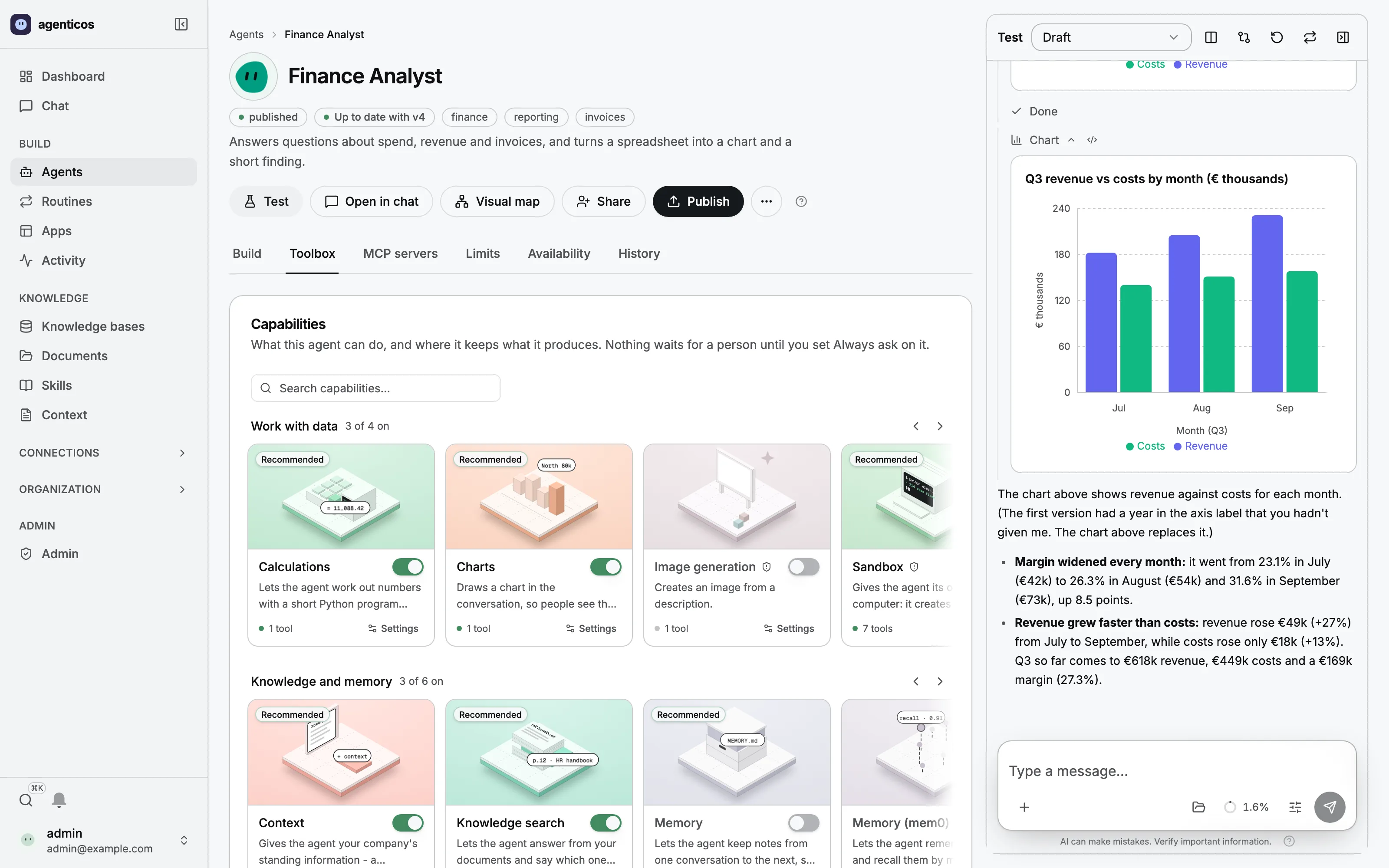
Work together
People and agents in shared Projects
Build around your work
Knowledge, tools, workflows and apps
Choose how it runs
Your infrastructure and model providers
AgenticOS vs Dify
Dify builds LLM apps and workflows on a visual canvas, self-hosted or in Dify Cloud. AgenticOS builds agents from instructions, capabilities, knowledge and a budget, and ships the controls a company asks for in the open-source product.
Jump to the side-by-side comparisonWhat you could put to work
Pick a job.
See it in action.
A useful agent should leave you with something you can use. Explore three examples from the AgenticOS product.
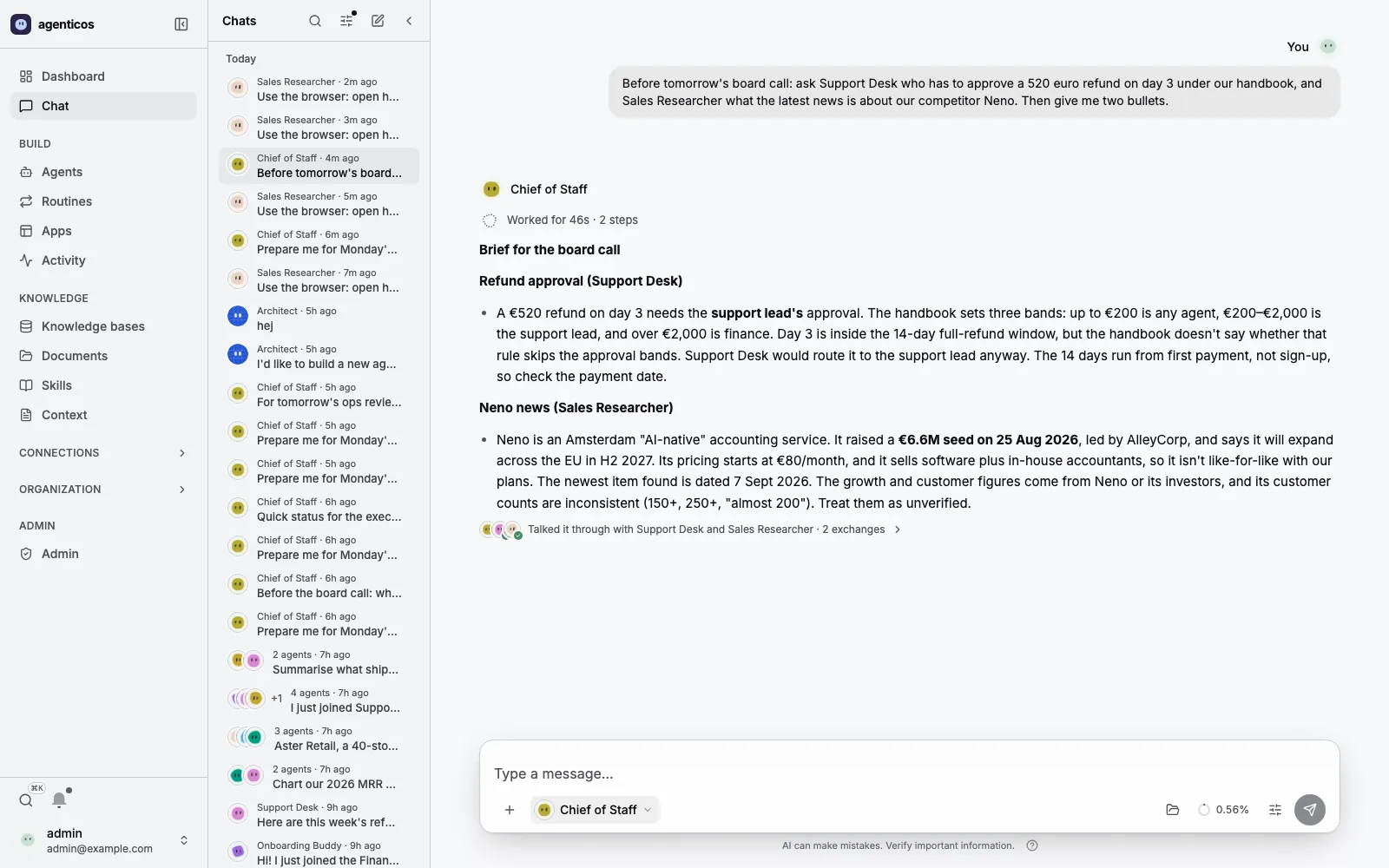
Research & operations
Ask the specialists. Get one brief.
Let a lead agent bring together research and analysis from specialist agents. In this example, the brief names its sources and flags the missing financial inputs instead of inventing a margin.
- 1.Define the question
- 2.Connect specialist agents
- 3.Review the combined brief
Make the platform fit the work
Build for your team.
Run it your way.
01
Multi-tenant without a commercial licence
Dify's licence forbids operating a multi-tenant environment without written permission, where one tenant is one workspace, and changing the logo in its frontend. AgenticOS is Apache-2.0: one deployment can serve every department, subsidiary or client, under your own brand.
02
The controls an enterprise asks for
Dify lists SSO, custom roles and multiple workspaces as Enterprise features. AgenticOS ships single sign-on, directory group mappings, roles with per-resource grants, a tamper-evident audit log and retention per data class in every deployment.
03
A budget that stops the next model call
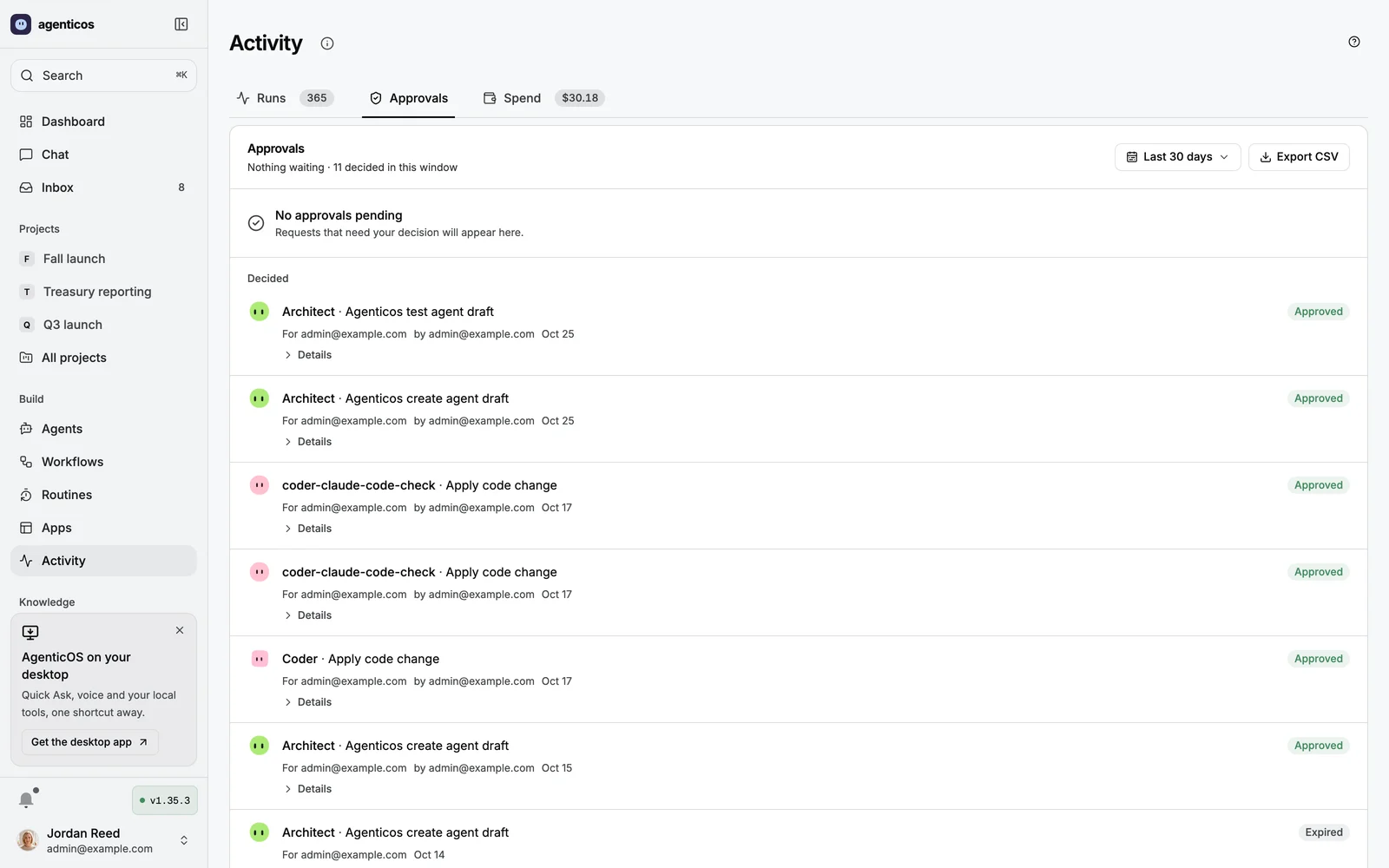
Dify's documentation describes no spend cap enforced before model calls in the Community Edition. AgenticOS checks each agent's budget and the organization's cap before each model request, and a failed run still records its cost.
04
Approval on the tool, not only in the flow
Dify's Human Input node pauses a workflow and sends a form, and the request closes after the first response. In AgenticOS an approval is set per capability, per tool and per MCP connection; the run parks, the people you choose are alerted, and a second decision on a decided approval is refused.
The software is Apache-2.0. Your team still owns hosting, model usage, updates and the policies it configures. Self-hosting alone does not mean zero outbound data.
Dify and AgenticOS, side by side.
How you build
- Dify
- A visual canvas of workflow, chatflow and agent nodes
- AgenticOS
- Versioned agents plus visual workflows with typed steps, branches and loops
Licence
- Dify
- Apache 2.0 with added conditions on multi-tenant use and the logo
- AgenticOS
- Apache-2.0
Tenancy
- Dify
- One workspace; several workspaces are Enterprise
- AgenticOS
- Many organizations in one deployment
Roles
- Dify
- Four built-in roles; custom roles are Enterprise
- AgenticOS
- Six roles, 33 permissions and per-resource grants
Sign-in
- Dify
- Email; SSO is Enterprise
- AgenticOS
- Email, Google, OIDC SSO, LDAP and Kerberos
Audit
- Dify
- Enterprise
- AgenticOS
- Tamper-evident audit log with CSV and JSONL export
Spend control
- Dify
- Provider billing, or Cloud message credits
- AgenticOS
- A monthly budget per agent and per organization, checked before each model request
Human approval
- Dify
- A Human Input node in a workflow
- AgenticOS
- Per capability, per tool and per MCP connection; the run waits until someone decides
Kubernetes
- Dify
- Community Helm charts; official high availability is Enterprise
- AgenticOS
- Docker Compose on one host, with an external Postgres and more hosts documented; no Kubernetes manifests
| Area | Dify | AgenticOS |
|---|---|---|
| How you build | A visual canvas of workflow, chatflow and agent nodes | Versioned agents plus visual workflows with typed steps, branches and loops |
| Licence | Apache 2.0 with added conditions on multi-tenant use and the logo | Apache-2.0 |
| Tenancy | One workspace; several workspaces are Enterprise | Many organizations in one deployment |
| Roles | Four built-in roles; custom roles are Enterprise | Six roles, 33 permissions and per-resource grants |
| Sign-in | Email; SSO is Enterprise | Email, Google, OIDC SSO, LDAP and Kerberos |
| Audit | Enterprise | Tamper-evident audit log with CSV and JSONL export |
| Spend control | Provider billing, or Cloud message credits | A monthly budget per agent and per organization, checked before each model request |
| Human approval | A Human Input node in a workflow | Per capability, per tool and per MCP connection; the run waits until someone decides |
| Kubernetes | Community Helm charts; official high availability is Enterprise | Docker Compose on one host, with an external Postgres and more hosts documented; no Kubernetes manifests |
Choose Dify when it fits the job.
- Your team thinks in flowcharts and wants a visual canvas of nodes, loops and branches.
- You need its marketplace plugins, its hybrid search with rerank or its observability integrations.
- One workspace is enough, or the Enterprise edition's terms suit you.
Run the platform. Make it your own.
- Your team wants to operate the platform and choose its infrastructure and model providers.
- You want shared Projects, configurable specialist agents and explicit workflows in one workspace.
- You want open-source software you can inspect and extend, and accept responsibility for operating it.
Before changing your setup
Both self-host and both handle document retrieval, so the choice is less about features than about the licence and the controls you need. Run the same handbook questions in both, then create a second tenant and give an agent a budget of a few cents, and compare what each allows.
What people ask before they switch.
Is AgenticOS an open-source alternative to Dify?
Yes. Both self-host and both handle document retrieval. AgenticOS is Apache-2.0 with no multi-tenant or logo conditions, and it includes SSO, roles, budgets, approvals and a tamper-evident audit log without an enterprise edition.
Can Dify run as a multi-tenant service?
Dify's licence requires written permission to operate a multi-tenant environment, where one tenant is one workspace. AgenticOS serves many organizations from one deployment under Apache-2.0.
Does AgenticOS have a visual workflow builder like Dify?
Yes. AgenticOS includes a visual workflow builder with typed steps, branches, loops and published versions. Compare the nodes and integrations your task requires with Dify’s ecosystem.
Which one costs less to run?
Dify Community Edition and AgenticOS are both free to self-host; you pay for models and infrastructure. Dify's Enterprise features are priced by its sales team. In AgenticOS those controls are already in the open-source product.

Make the choice on your own task
One useful agent.
Start there.
Bring a handbook question, a recurring report or a small research task. Build one agent and decide whether this is the workspace you want to run.
Try it on your own infrastructure
Start with the installation guide and a model connection. No software licence fee; infrastructure and model usage are separate.
curl -fsSL https://raw.githubusercontent.com/vstorm-co/agenticos/main/scripts/quickstart.sh | bashComparison by Vstorm, the team building AgenticOS. Vendor sources checked 21 October 2026.
Documented capabilities, not a head-to-head benchmark. Read the sources and comparison scope.